Showing posts with label Andalusia. Show all posts

Monday, 20 October 2014

A day trip to Ronda

Ronda is a quaint little town in Andalusia that was one of the last Moorish bastions in Spain. It finally fell to the Christians in 1485. The reason why it remained for so long in the hands of the Moors is that Ronda is located perched atop of a 330 foot gorge, with a bridge crossing from the old to the new town. This gave the Moors the advantage with repelling intruders from their hilltop location.

Above: an aeral shot of Ronda (a postcard I bought). The bridge is in the bottom centre-right of this photo (in shadow). You can see the bullring in the bottom left of the photo, with its classic ochre coloured sand in the centre of the ring.

The train ride from Málaga to Ronda takes about two hours and cost about €8 return for an adult ticket with a rail pass. There are only two trains to Ronda from Málaga per day, and only one train return, so I had to make the most of my 4.5 hours while I was there. The terrain that I traveled through was very arid and mountainous. It felt like another world from the gardens and beaches of Málaga. Olive trees dot the landscape in all directions. 


Next two photos: One of the best places to take in the view of the bridge is the delightful Casa de Bosco. The €2 entry fee affords a view framed by it's garden and fountain that is hard to rival.
 

Ronda is very walkable, from the train station to the tourist office is about a 15 minute walk downhill. The old town has so many museums, it was hard to choose what to see. Most of the people in the tourist office and restauranteurs speak about four languages! English, French, German, and of course, Spanish. Many tourists visit Ronda to see the bridge and the gorge but also because Ronda is the home of bullfighting. The Plaza de Toros bullring is the oldest in the world - 18th century - but the bullfighting cooperative (Real Maestranza) has existed since 1572 in Ronda. The first bullfight in the ring took place in 1785, when local matador hero, Pedro Romero, created a new and modern style of bullfighting. Romero himself killed over 6000 bulls in his lifetime. He even has a street named after himself in the town. Ronda hosts the Corrida Goyesca each September and millions watch it on TV. It is the dream of aspiring matadors to fight at Ronda during this competition.

Above: the bullring and gate number 5. Visitors can tour the bullring and take in a small museum about the history of bullfighting. It is the first building in the world built specifically for the purpose of bullfighting.

Below: the larger-than-life bull statue outside the ring.

I am, admittedly, not a fan of bullfighting. To be honest, I feel that it's cruel to tease, wound, and finally kill an animal in the name of "sport." But, this is not my culture, I'm merely a visitor to this culture. However, it is interesting to note that in Catalonia they have banned the sport of bullfighting for the reasons I've mentioned. I don't fully understand the "why" of this sport. I wanted to visit the museum inside the bullring to gain a better understanding of the history and development of bullfighting. But due to short duration of my trip and the timing of the trains, I was unable to do so. Entry is approximately €7 for an adult ticket and audioguides are available.

Ronda has inspired many writers and artists over the years - Hemingway, Rilke, and other poet types fell in love with it's whitewashed houses, beautiful vistas, and charming winding little streets. It's easy to see why artistic types would be drawn to this town. Here are some views to take in:
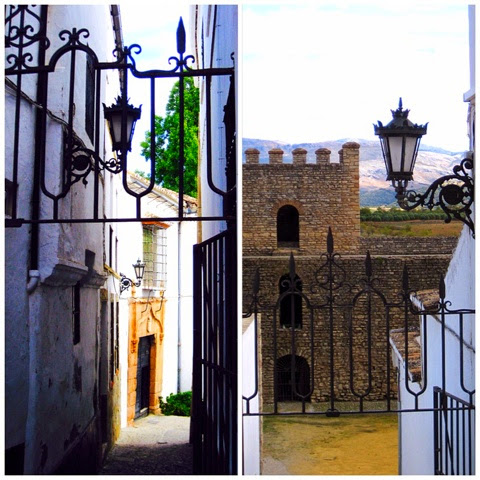
Above right: the remains of the Moorish wall and battlements can be seen peeking down the narrow streets. 

Above left and below: typical houses and views from within the old part of town.

The museum that I spent te most time in is the Lara Museum, which holds an eclectic mix of artifacts from 17-19th centuries, inluding: clocks, watches, sewing machines, hand painted fans, opera-glasses, vintage microscopes, carriages, photography and movie cameras, ornamental guns, a rather ridiculous witchcraft exhibit, and these oddities:
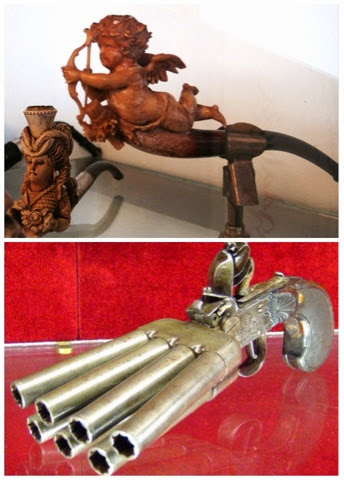
Above: handcarved pipes that are quite the works of art. Second photo is of a seven-barrelled handgun that was used to dispel mutinies aboard sea-going vessels. How this was achieved is rather up to interpretation, however.

The part of the museum that I was most interested to visit was their exposition on the Spanish Inquisition. After being disappointed in Seville at the Castillo de St. Jorge, I was not disappointed in Ronda. Perhaps I have a morbid sense of curiosity. But I think it's more that I'm baffled and amazed at how humans can be so malicious towards each other. The Lara museum had an array of torture devices and explanations of how they were used. 

Below: This man, Thomás de Torquemada, was known as the "hammer of heretics" because he was overly zealous in his pursuit of cleansing the population of supposed non-believers.

Above: the inquisitior's court. The alleged heretic was clapped in chains and a cone was placed upon his or her head depicting satan dancing around a fire while the two inquisitors questioned the person. Prisoners were considered guilty upon arrest until proven innocent. More often than not, victims of the Inquisiton died from torture before their innocence could be "proven."

Below: a wax model of a woman suspended while being tortured to entice her to confess her heretical crimes. Right - a copy of the Iron Maiden of Nuremberg. The victim was placed inside and the spiked doors were slowly closed upon the person within.

The museum also has a rack, a garotte (a chocking device that was used in Spanish prisons until the death of dictator General Franco in 1975), a head-crusher (which is still used as a device of interrogation but non-lethally), and most disturbing of all - a Judas Cradle. I won't describe what this last torture device looks like or how it's used...if you are really curious, google it. Suffice to say, it looks like the most cruelly painful device ever imagined by a human mind. Even the guillotine is more merciful. I'm sure Europe breathed a collective sigh of relief when the Inquisition finally ended in the 18th century. I'm amazed that it lasted so long.

I wish I had either visited Ronda as a day trip from Seville (where more trains are available) or that I stayed overnight to take in more attractions, like the Bandelero Museum which is an exposition of bandits, highwaymen, and the development of the Spanish civil police to track and catch these brigands. If I'm back this way again some day, I will definitely be returning to Ronda. 


Monday, 13 October 2014

Much ado about Málaga

Málaga is a pretty port city on the eastern Andalusian coast. It, like other cities on my journey, was a former Roman colony where fish was the primary commodity. The city has a few archeological sites of import - an exposed Roman amphitheatre at the foot of the 8-11th century CE Alcazaba - but is essentially a modern city. The main draw of tourists to Málaga is it's beaches, of which there are several very close to the downtown core. I was glad to arrive at the beginning of October when the majority of the beach going tourists had vacated the city. My hostel (Patio 19) was fairly quiet as a result, but I didn't mind having a bit of relaxation after running around both Seville and Córdoba.

To get acquainted with the town, I went on the free walking tour arranged by another hostel (the Oasis). Unfortunately, the walking tour guide (who was Italian) didn't have the best English, so it was difficult to follow along with what he was saying. I probably didn't help matters by correcting his English idioms but as a former English language teacher, I only wanted to assist him as he struggled to narrate our tour. We started in the main square, the Plaza de la Constitucion (next two photos).


Afterwards, he took us to the Cathedral, which has the nickname of the La Manquita or "one-armed lady" as the cathedral was to have two matching bell towers but funds as the time of its building were diverted to California. When funds became available, the church decided not to complete the second bell tower because the locals all knew the cathedral by its nickname, and colloquialism trumped completion-ism. After seeing many churches & cathedrals along my winding road of a journey, I decided to save my money and skip visiting this one. Here are a few shots of the outside of the cathedral.


Below: stained glass adorns the entrance to the public market. There is a dazzling display of produce, fungi, Málaga almonds, and fish. The market closes by 2pm.

Málaga is the birthplace of the father of cubism - Pablo Picasso. He lived there until about age 16 when he went off to art school. He last was in Málaga for Christmas during his 20th year before going to Paris, where he was influenced by the French school of painting. Critics say that Picasso really became an artist in Paris, that it matured his style. The Meseo Picasso Málaga displays a broad spectrum of his works in various media and styles. It was his express wish that a museum be founded in his home town, and his daughter-in-law and grandson made that wish a reality. The museum is open every day until 8pm except Mondays, and an adult ticket costs €8 with €1 for an audioguide (well worth it in my opinion). The museum's best feature is a film about Picasso's life,where you can see this quirky artist entertaining guests and working, while the narrator (in English with Spanish subtitles) describes parts of his life and the evolution of his artwork. Picasso is best known for developing cubism, but he really did paint in every style and dabbled with ceramics and sculpture. The visit takes approximately two hours.


The other thing Málaga is known for is their sweet wines, particularly Pedro Ximen. There are three varieties of this Málaga wine: dry white, sweet (almost like a tawny port), and semi-sweet, which is a blend of the other two. I had the opportunity to taste all three varieties during my walking tour at a wine bar called Antigua Casa de Guardia which has been in business since 1840 and four generations of the same family work there. A glass of wine costs only €1.40, and it's for this reason that the bar closes by 7pm to dissuade folks from coming in at night to get drunk for cheap. You can source these wines at local bars around town as well. My favourite was the semi-sweet wine. 


Below: the excavated Roman amphitheatre and Moorish Alcázba rising above it, lit up at night in downtown Málaga.

The food in Málaga varies greatly depending on where you eat and how much you are willing to pay. I had only one meal that really pleased my palette, which was at the Mesón de Cervantes which is affiliated with a restaurant literally 30 feet away (Tapeos de Cervantes). There I had some very tasty tapas, wine, and a desert to die for. Most nights, I made myself a giant salad from fixings derived at the local supermarket, and washed down with a cheap (€2.65) but great Roja wine. Thank goodness for kitchens in hostels!

Below: the very delectable meal I had at Mesón de Cervantes (cost around €14).

On my fourth day in Málaga, I rented a bicycle for an entire day (€10) to go to the beach. I wanted to cycle outside of the town as I was informed by my walking tour guide that the city's beaches were artificial, and I wanted to have some more peace and quiet. The bike ride along the beach is a pedestrian/cycling route only, which made it not only safe, but enjoyable as well. I cycled for about an hour and spotted a nice sheltered beach with coves on both sides which made it great for swimming. The water was crystal clear and very salty. The views reminded me so much of Mexico, I wonder if the Spanish felt at home there when they first landed. All the beaches along the waterfront are wheelchair accessible, and most have accessible toilets as well.


The day before I left Málaga, I took in the Museo de Artes Populaire in the former Mesón de la Victoria inn (18th century). This museum depicts the life and culture of Málaga in the 18th and 19th centuries in terms of farming, clothing, crafts, and religion. Entrance costs €4 for an adult but no audioguide is available (which would have greatly enhanced the experience in my opinion). A few items stood out from my visit:

Above: a press to pound grapes into the delicious sweet wines the region is famous for.

Below: raisin box liners from Málaga - I think this looks like a work of art. It's hard to imagine it lining a lowly raisin box.

Below: a dress from the 19th century that would've been worn by a bourgeoisie woman. I thought it was stunning to behold. 

On my last night in Málaga, I went with two ladies from my hostel to take in a live music show (which sadly wasn't flamenco) at the famous Bodega El Pimpi where many famous Andalusian (like Málaga-born António Banderas) frequent to sign the wine barrels. I think Banderas actually added the new upstairs modern section as his last name is written on a life-ring mounted on the wall. No visit to Málaga would be complete without a visit to this bar/restaurant. It's sandwhiched between the Alcázba and the Picasso Foundation. 


I was hoping to have another beach day before I left for Morocco, but alas, 'twas not meant to be. I did however, manage to squeeze in a day trip to Ronda, which shall be the subject of my next blog post.


Sunday, 5 October 2014

Sevilla, part two - a tour of the senses

Seville is as much about enjoying the sensual journey as it is about taking in the history and architecture of the city. You get hit on every sensory level - sights, sounds, smells, tastes, touch. It's no wonder why I fell in love with the place; indeed, I chose to stay another day rather than head over to Córdoba on (my) schedule. The days started to blur together, so it's hard to tease out when I did what exactly. But here are some things I experienced while in this beautiful place.

My guidebook hooked me with an image of one of the barrel-vaulted ceilings within the Museo de Belles Artes (the photo above is mine). As someone who appreciates a beautifully styled art gallery as much as the artworks themselves, I had to go see it for myself. This museum features artworks predominantly depicting Christian themes: I saw several versions of the Immaculate Conception, Assumption of the Virgin, and various saints and visions. It makes sense that this would be the bulk of this gallery's collections given the intensity of Spain's devotion to those topics over the centuries (hello Inquisition). Because I went late in the day, the gallery clerk let me in for free (normally the museum is €1.50 for non-EU citizens, otherwise it's free). 

Next two photos: A few pieces caught my attention, like this Jewish writing desk (top), and this painting of Seville from the late 16th/early 17th century (bottom). You can see the bell tower of the cathedral prominently displayed in the centre of the piece.


One of the best things I did while in Seville was partake in the walking tours arranged by my hostel. These were "free" in that you didn't pay upfront for the tour, but evaluated and gave what you thought was fair payment at the end of the walk. For both walks Fillippo (a funny, and fast-walking Italian) was our guide. The first walk I went on was through the Jewish quarter of Santa Cruz. There was some interesting (and also tragic) stories from that quarter. The second walk was a more general overview of Seville. One of the most impressive things we walked to was Plaza d'España which was built for the Iberian-American Expo in 1929. Looking at my camera, I really wish I had taken more photos. This place is huge! All 49 of Spain's provinces are represented in alphabetical order around the semi-circle structure with important historical or literary references depicted in the tile work.

Below: me in front of the main pavilion of Plaza d'España. 

Next two photos: the surrender of Granada to the Christians and Don Quixote "attacking" the windmills of La Mancha. 

The next day I was feeling a bit depleted with all that walking, so I decided to take a day off and have some pampering. My body was sore and I knew it was time for self-care so that my chronic pain wouldn't debilitate me. I went to the Aire Baños Árabes to relax in the various pools (salt, hot, lukewarm, cold, jacuzzi) and to breathe in the aromatherapy of the hammam steam room. This portion cost €27, and I elected to not have a massage there as it was pricey and I had a recommendation for a local Japanese woman who did shiatsu. I felt much better after both treatments.

That night, I went to see a flamenco show at El Palácio Andaluz, which was considered by many to be "pure" flamenco. The show cost €16 when booked through my hostel, otherwise the cost is €38 at the door! I was seated on the left side of the "orchestra" seating (there was an upper mezzanine level as well) at the end of the row, which allowed me to get up to stretch my legs and to get a better view of the performers. The show is very professional, and you can see how much passion the dancers had for their chosen art form. Two dancers stood out in my mind, and are pictured below. There was even a 12 minute flamenco adaptation of the opera Carmen which I absolutely adored. Flamenco is as much about the swirling, intense dance as it is about the music, the rhythmic pounding of feet, and the clapping of hands. A veritable feast for your eyes and ears! There was a museum of flamenco located below the theatre level, but I missed the opportunity to visit.

Above: me all dolled up to go watch the flamenco show.

Below: two of the best of the professional dancers from El Palácio Andaluz.

On my last full day in Seville, I decided to go to Triana (across the canal) to visit what was left of the Castillo de San Jorge and to check out the famous ceramics of Santa Anna. The museum inside the remains of the Castillo is free, and the exposition centres on the Spainish Inquisition as this former citadel was the seat of the Inquisition for more than 300 years (from 1481 to 1785). The museum is literally bare bones: a few ruins, a few descriptions of victims (but not how they were tortured, perhaps too gory?) and a multimedia theatre (only the sound worked, the video was broken - but hey, the museum was free) presentation about the sad end of an innocent young widow who was thrown into the hands of the Inquisition by a jilted lover. She finally "confessed" to being a witch after being tortured in a lightless cell after three years. She died before she even could make it to the stake to be burned alive. So sad.

Above: a painting depicting the castle's ominous presence (left) from the viewpoint of the Torre del Oro (right). It's imposing size was a symbol of the Inquisition throughout Europe. Thousands of people suffered and died in the cells and dungeons therein, or at the stake.

The Inquisition was probably the darkest period of Spanish history. Originally, the Inquisition's goal was to seek out seemingly converted Jews and Muslims who were still practicing their old beliefs and traditions in order to create a homogenous religious population within Spain. But the thing spiralled out of control as neighbours informed on each other, people in power abused their authority and fanaticism ran rampant. Even Saint Theresa was not without threat, as her book called Life came into question and the inquisitors saught to find her at fault. But she just laughed and shrugged it off and said "I had never felt afraid of anything." Brave words! 

Below: Saint Theresa not giving two hoots about the Inquisition.

The museum visit ends with a wall showing certain articles from the UN Declaration of Human Rights. I feel that this museum could have been so much more than it was. If the city invested in it, and charged admittance, it could really be something. But I get the feeling that the Spanish want to sponge this terrible history from their minds, which is probably why the citadel was taken down and the land given to Triana to become its current public marketplace.

Lastly, I want to talk about the food of Seville. It is amazing! Tapas bars abound, where you can have a filling meal and a couple glasses of wine for about €12. You can either stand at the bar or wait for a table. I went to one tapas bar (the Coloniales) almost every day, and the staff learned my name, and I introduced my friends from the hostel to this place. On the walk back from Triana, I found a great restaurant with some tasty tapas. Here's a sample of a traditional tapas meal:

Thursday, 2 October 2014

Sevilla, part 1 - down the rabbit hole

When I told my friend and RMT Jamie that I was going to Seville, she recommended that I take my time and enjoy all that it has to offer. I asked her how long she was there last, and her reply was, "I went for five days, but I could've stayed forever." After spending the past week in Seville, I understand what she meant, and feel like I fell down the rabbit hole and in love with the place. I'm getting nostalgic just writing this post about it...

Above: the plaza adjacent to both the cathedral and the Real Alcázar.

Seville is a beautiful city, and in my opinion, it could rival Paris with its ornate buildings, long history, and great restaurants. It is very hot here though, and it's known as the "frying pan of Spain." Seville set the Guinness book of world records for hottest day In summer - 53 degrees Celcius in the shade. I can't imagine living in that heat. It's a large city but still very assessible on foot despite the myriad of winding tiny streets with multiple names, and maps that are more confusing than my internal compass seems to be.

After a four hour bus ride from Faro, I felt disorientated upon alighting in Seville. It was busy, loud, and the language had changed from Portugese to Spanish. My hostel (the Garden Backpacker) was awesome. Super friendly staff & guests that became friends, free sangria hour ( = DOOM), yummy cheap dinners, and free walking tours has made it the best hostel I've stayed in to date on my trip. Check them out. The hostel reception gave me several maps, and after settling in, I wandered off to explore this veritable wonderland of a city. 

First stop, the "Mushrooms" or Metropol Parasol, a funky modern art installation built on some Roman ruins. €3 gets you an elevator ride to the top of the mushrooms and a free drink. The parasol has a walkway on top to see views of the city. Honestly, I preferred the view for underneath the mushrooms, and felt a bit like Alice, lost in Wonderland.
Mushroom, mushroom!

Seville has what feels like a million little narrow winding streets that seem to double back on themselves. And yet, when I stumbled upon the Cathedral and the Real Alcázar, it felt like a natural funnelling towards the historical centre and heart of the city. As I arrived in the late afternoon, I missed out on the cathedral that first day (public visits close at 5pm). So I tried my luck across the way at the palace and discovered it was open until 7pm (as it was still September). 

 Above: the entrance to the Real Alcázar or royal palaces of Seville. These are still used by Spain's royalty to this day. Indeed, it is the oldest royal palace in Europe still in use.

The Real Alcázar was originally built by the Moors in the 11th century, and Islamic art and architecture are in abundance. In 1364, when Pedro I ordered the construction of a royal residence within the existing structure of the Real Alcázar, rather than tearing down all the beautiful arches and building anew, he requested that Christian visigothic additions be made, which created a new, blended style of architecture called Mudéjar. The results are palaces that are opulent as well as balanced. I recommend a minimum of two hours to visit this site. An adult entry ticket costs €9.50 (students only €2 with a valid student ID), and I chose to have the audio guide for an additional €5 because I was tired of reading information on the plinths. My only beef with the audio guide tour was that it wasn't laid out in an easy to follow path. I had to search for the next room, which sometimes meant going back through previously viewed/discovered rooms to find the next audio guide spot. Regardless, the trip to the royal palaces and gardens were definitely worth it. If one does nothing in Seville (with the exception of drinking sangria and eating yummy tapas), one must visit the Real Alcázar. I took many photos, what follows is a very small sample of what lies within the palaces.

Above: The Patio of Maidens, one of the more beautiful "patios" of the palaces. The Islamic influence is everywhere, from the central water feature to the carved plasterwork (created by artists from Granada) of the Moorish arches. It was a pleasure just to sit here and take in the relaxing mood from the place. 

Below: horseshoe arches adorn the insides of the Hall of Ambassadors, probably the most impressive room of the entire palace.

Above: a tapestry depicting conquests of the "new world" by the Spanish. This tapestry covered an entire wall, I can only imagine how long it took to weave the thing.

Below: Islamic wall adornment giving praise to Allah in the script underneath. This adornment runs along the length and width of the room, sort of like wainscotting.

The gardens are very enjoyable, with tall palms and plentiful orange trees provide shade in the 30 degree + heat of Seville. I spent about an equal time in the gardens as I did the palace. There's even a fountain in the middle of the grotto gallery that plays organ music every hour, on the hour (although it no longer spurts water; it is one of only three fountains that plays music via a complex arrangements of mechanics.) A maze and an English garden round out the scenery.

Day two: I decided that since I missed the cathedral the first day, I was going to go back and see it properly. At €8 for an adult ticket, I felt that the cathedral of Seville (the largest in Europe) was overpriced. However, it did have some amazing views within, as well as from the climb and apex of La Giralda tower. The Cathedral, like many churches in Andalusia, was built overtop of a mosque. If you go around the outside of the cathedral, you can see some blind Moorish arches giving a hint of this history. 

Above: the cathedral by night, a magical sight.

Although the inside of the cathedral is impressive in size, scope, and adornment, what really takes the cake in my mind is the climb up the tower. No building in Seville (with the exception of one ugly modern skyscraper belonging to a bank) is allowed to be taller than the tower of La Giralda. In my humble opinion, I much preferred the views of Seville from this tower rather than the "Mushrooms." 

Below: La Giralda tower by day and night. This bell tower used to have a minaret when it was a part of the mosque. The call to prayer was sung from the top of this tower. Instead of stairs circling up the tower, a ramp with 35 turns is inside. This makes it assessible to wheelchair users and folks with tots in strollers. But the ramp was actually incorporated during the time when this cathedral was a mosque, as the caller would ride a donkey up and down the tower to save his legs (five times a day for normal days, twelve times a day during the holy month of Ramadan!) 

Below: Here's the view looking down at the orange garden and the exit of the cathedral. This was actually the original entry of the mosque and was the place for Muslims to make their ablutions at the central fountain before entering the holy structure.

Above: looking out at the gothic adornments from one of the many windows while climbing the tower.

Below: a sweaty but successful me after climbing the tower.

The interior of the Cathedral of Seville is impossible to capture with a simple point-and-shoot camera. But I tried...

Below: Left - a view of the nave and gothic arches overhead. Right - the organ is built from floor-to-ceiling on either side of the high alter. The wood comes from Cuba. It can only imagine the sounds it would emit.

Above: a portion of the high alter, which was impossible to capture in one photo. Most of the gold came from the conquests (read: pillaging and massacres) of cultures from Central & South America.

Below: the central apex of the gothic arched ceiling. The cathedral has a large mirror which one can look up without straining ones neck to get a view of the ornate plasterworks. 

I'll continue my adventures in Seville with the next blog post (or two!) as there was so much to take in during my week-long stay there.